RICH Detector with Optical Photons Offloaded to a GPU
This example continues the RICH Detector with Offloaded Optical Photons example. The optical photons are again collected by the stacking action and killed, but they are now propagated on a GPU. The propagator in RICHTracerGPU.jl is a port of the CPU ray tracer to a KernelAbstractions.jl kernel, with one GPU thread per photon. The same kernel runs on Apple GPUs (Metal.jl), NVIDIA GPUs (CUDA.jl), AMD GPUs (AMDGPU.jl), or on the CPU with Julia threads.
A GPU needs many photons at once to be efficient: launching a kernel and copying the data costs some tens of microseconds, about the time the CPU needs to propagate the few hundred photons of one event in this detector. The photons of many events are therefore collected and offloaded together in batches, and the hits are reconstructed when the results come back.
The example shows:
- choosing a KernelAbstractions backend (CUDA, Metal or CPU threads) and the floating point precision
- collecting the photons of several events and offloading them in batches, including the last incomplete batch in the end-of-run action
- comparing the hits and the reconstructed Cherenkov angles with the CPU propagator
- measuring the throughput of the CPU and GPU propagators as a function of the batch size
You can also download this example as a Jupyter notebook and a plain Julia source file.
Table of contents
- Loading the necessary Julia modules
- Choose the backend
- Detector, physics and primary generator
- The CPU and GPU propagators
- Define the Simulation Data
- Reconstruction of the Cherenkov angle
- Offloading a batch
- Define the User Actions
- Create the Application
- Configure and Initialize
- CPU versus GPU propagation
- Single photon resolution
- Throughput as a function of the batch size
Loading the necessary Julia modules
In addition to the modules of the RICH example we load KernelAbstractions and a GPU package: Metal on macOS and CUDA elsewhere. Both can be loaded on machines without a GPU.
using Geant4
using Geant4.SystemOfUnits
using Geant4.PhysicalConstants
using FHist, GeometryBasics, Printf
using LinearAlgebra: dot, normalize          ## Geant4 also exports `dot`
using KernelAbstractions
if Sys.isapple()
    using Metal
else
    using CUDA
end
using CairoMakie
Choose the backend
We use an NVIDIA GPU (CUDA) or an Apple GPU (Metal) if there is one, and otherwise the CPU backend of KernelAbstractions (with as many threads as Julia was started with, e.g. julia -t auto). GPUs use single precision: Apple GPUs do not support Float64, and most NVIDIA GPUs (except the data-centre ones, such as A100 or H100) are much slower in double precision. On those you can set T = Float64; the geometrical tolerance of GPUTracer{T} follows the precision.
backend, T = if @isdefined(CUDA) && CUDA.functional()
    CUDABackend(), Float32
elseif @isdefined(Metal) && Metal.functional()
    MetalBackend(), Float32
else
    CPU(), Float64
end
@printf "Backend: %s, precision: %s, Julia threads: %d\n" backend T Threads.nthreads()
Backend: KernelAbstractions.POCL.POCLKernels.POCLBackend(), precision: Float64, Julia threads: 4
Detector, physics and primary generator
The detector, the physics list and the primary generator are the same as in the RICH Detector example. The detector is defined in RICHDetector.jl.
include(joinpath(@__DIR__, "RICHDetector.jl"))
rich = RICHDetector()

struct RICHPhysics <: G4VUserPhysicsList
    function RICHPhysics(verbose)
        pl = FTFP_BERT(verbose)
        RegisterPhysics(pl, move!(G4OpticalPhysics(verbose)))
        return pl
    end
end

mutable struct RICHGunData <: G4JLGeneratorData
    gun::Union{Nothing, CxxPtr{G4ParticleGun}}
    particles::Vector{String}
    pmin::Float64
    pmax::Float64
    θmin::Float64
    θmax::Float64
    ##---the current track
    particle::String
    mass::Float64
    momentum::Float64
    direction::Vec3{Float64}
end

function RICHGunGenerator(; particles=["pi+", "kaon+", "proton"], pmin=1GeV, pmax=80GeV, θmin=50mrad, θmax=250mrad)
    data = RICHGunData(nothing, particles, pmin, pmax, θmin, θmax, "", 0., 0., Vec3(0.,0.,1.))
    function init(data::RICHGunData, ::Any)
        data.gun = move!(G4ParticleGun())
        SetParticlePosition(data.gun, G4ThreeVector(0, 0, 0))
    end
    function generate(evt::G4Event, data::RICHGunData)::Nothing
        gun = data.gun
        data.particle = rand(data.particles)
        SetParticleByName(gun, data.particle)
        data.mass = gun |> GetParticleDefinition |> GetPDGMass
        data.momentum = data.pmin * (data.pmax/data.pmin)^rand()
        cosθ = cos(data.θmin) - rand() * (cos(data.θmin) - cos(data.θmax))    ## uniform in solid angle
        sinθ, ϕ = sqrt(1 - cosθ^2), 2π * rand()
        data.direction = Vec3(sinθ * cos(ϕ), sinθ * sin(ϕ), cosθ)
        SetParticleEnergy(gun, sqrt(data.momentum^2 + data.mass^2) - data.mass)    ## kinetic energy
        SetParticleMomentumDirection(gun, G4ThreeVector(data.direction...))
        GeneratePrimaryVertex(gun, CxxPtr(evt))
    end
    G4JLPrimaryGenerator("RICHGun", data; init_method=init, generate_method=generate)
end
generator = RICHGunGenerator()
Geant4.G4JLPrimaryGenerator{Main.var"##142".RICHGunData}("RICHGun", Main.var"##142".RICHGunData(nothing, ["pi+", "kaon+", "proton"], 1000.0, 80000.0, 0.05, 0.25, "", 0.0, 0.0, [0.0, 0.0, 1.0]), Main.var"##142".var"#init#10"(), Main.var"##142".var"#generate#11"(), Geant4.G4JLGeneratorAction[])The CPU and GPU propagators
RICHTracer.jl defines the OpticalPhoton structure, the RICHTracer geometry constants and the CPU propagator propagate(tracer, photon). RICHTracerGPU.jl defines the module RICHGPU with:
GPUPhoton{T}: the photon state in precisionT, with its energy-dependent properties (the refractive index of the gas, the Rayleigh scattering length and the quantum efficiency), which we evaluate on the hostGPUTracer{T}: the geometry constants in precisionT, converted from aRICHTraceroffload(backend, tracer, photons): copies the photons to the device, runs the kernel and returns aGPUHit{T}(detected or not, and the position) for each photon
include(joinpath(@__DIR__, "RICHTracer.jl"))
include(joinpath(@__DIR__, "RICHTracerGPU.jl"))
using .RICHGPU
tracer = RICHTracer(rich)
gputracer = GPUTracer{T}(tracer)

toGPU(::Type{T}, p::OpticalPhoton) where T = GPUPhoton{T}(p.position, p.direction, p.polarization, c4f10RIndex(p.energy),
                                                          aerogelRayleigh(p.energy), quantumEfficiency(p.energy))
floattype(::GPUTracer{T}) where T = T
floattype (generic function with 1 method)Define the Simulation Data
The Hit, Photon and Track structures are the same as in the RICH example. The photons collected by the stacking action are appended to pending, together with the index of their event in pendingEvent, until a batch of batchSize events is complete. The mode selects the propagator: :cpu, :gpu, or :collect to only keep the photons in sample.
struct Hit
    position::Point3{Float64}
    energy::Float64
    radiator::Symbol            ## :aerogel or :gas
    primary::Bool               ## produced by the primary track
end
struct Photon
    event::Int
    θc::Float64                 ## reconstructed Cherenkov angle
    radiator::Symbol
    primary::Bool
end
struct Track
    particle::String
    mass::Float64
    momentum::Float64
    direction::Vec3{Float64}
end

mutable struct RICHSimData{B, GT} <: G4JLSimulationData
    ##---Configuration------------------------------------------------------------------------------
    mode::Symbol                                   ## :cpu, :gpu or :collect
    batchSize::Int                                 ## number of events per offload
    backend::B                                     ## KernelAbstractions backend
    tracer::RICHTracer                             ## CPU propagator
    gputracer::GT                                  ## GPU propagator
    opticalphoton::CxxPtr{G4ParticleDefinition}
    ##---Batch data---------------------------------------------------------------------------------
    pending::Vector{OpticalPhoton}                 ## photons waiting to be offloaded
    pendingEvent::Vector{Int}                      ## index of the event of each pending photon
    ##---Run data-----------------------------------------------------------------------------------
    tracks::Vector{Track}
    photons::Vector{Photon}
    sample::Vector{OpticalPhoton}                  ## photons kept in :collect mode
    nOffloads::Int                                 ## number of batches offloaded
    nOptPhotons::Int                               ## number of photons offloaded
    offloadTime::Float64                           ## time spent in the propagator (and the copies)
end
RICHSimData(backend, tracer, gputracer; mode=:gpu, batchSize=100) =
    RICHSimData(mode, batchSize, backend, tracer, gputracer, CxxPtr{G4ParticleDefinition}(C_NULL),
OpticalPhoton[], Int[], Track[], Photon[], OpticalPhoton[], 0, 0, 0.)Main.var"##142".RICHSimDataReconstruction of the Cherenkov angle
The same as in the RICH example.
function reflectionPoint(E, D, C, R)
    a, b = E - C, D - C
    â = normalize(a)
    ĉ = normalize(b - dot(b, â) * â)
    mirrorpoint(φ) = C + R * (cos(φ) * â + sin(φ) * ĉ)
    function g(φ)                                  ## difference of the cosines of the two angles
        M = mirrorpoint(φ)
        m = normalize(M - C)
        dot(normalize(E - M), m) - dot(normalize(D - M), m)
    end
    lo, hi = 0., atan(dot(b, ĉ), dot(b, â))
    for _ in 1:40
        mid = (lo + hi) / 2
        g(mid) < 0 ? (lo = mid) : (hi = mid)
    end
    return mirrorpoint((lo + hi) / 2)
end

function sphereIntersection(t, C, R)
    b = dot(t, C)
    return b + sqrt(b^2 - dot(C, C) + R^2)
end

const nGas = c4f10RIndex(3.2eV)

function cherenkovAngle(det::RICHDetector, track::Track, hit::Hit)
    t = track.direction
    side = hit.position[2] > 0 ? 1 : -1
    C = Point3{Float64}(mirrorCentre(det, side)...)
    zAerogel = det.aerogelZ + det.aerogelThickness
    if hit.radiator == :aerogel
        s = (det.aerogelZ + det.aerogelThickness/2) / t[3]
    else
        s = (zAerogel / t[3] + sphereIntersection(t, C, det.mirrorRadius)) / 2
    end
    E = Point3{Float64}(s * t)
    M = reflectionPoint(E, hit.position, C, det.mirrorRadius)
    d = normalize(M - E)
    if hit.radiator == :aerogel
        dt = Vec3(d[1], d[2], 0.) * nGas / det.aerogelRIndex
        d = Vec3(dt[1], dt[2], sqrt(1 - dot(dt, dt)))
    end
    return acos(clamp(dot(d, t), -1., 1.))
end

function expectedAngle(n, m, p)
    β = p / sqrt(p^2 + m^2)
    nβ = n * β
    return nβ > 1 ? acos(1/nβ) : NaN
end

radiatorOf(det, zvertex) = zvertex < det.aerogelZ + det.aerogelThickness + 1mm ? :aerogel : :gas
radiatorOf (generic function with 1 method)Offloading a batch
flush! propagates all the pending photons, with the CPU or the GPU propagator, and reconstructs the Cherenkov angle of the detected photons with the track of their event. With the GPU, the photons are first converted to GPUPhoton{T}, and the quantum efficiency is applied in the kernel.
function flush!(data::RICHSimData, det::RICHDetector)
    isempty(data.pending) && return
    if data.mode == :collect
        append!(data.sample, data.pending)
    else
        detected = Tuple{Int, Point3{Float64}}[]
        data.offloadTime += @elapsed begin
            if data.mode == :gpu
                gpuphotons = [toGPU(floattype(data.gputracer), p) for p in data.pending]
                for (i, h) in enumerate(offload(data.backend, data.gputracer, gpuphotons))
                    h.detected && push!(detected, (i, Point3{Float64}(h.position)))
                end
            else
                for (i, p) in enumerate(data.pending)
                    pos = propagate(data.tracer, p)
                    isnothing(pos) || rand() < quantumEfficiency(p.energy) && push!(detected, (i, Point3{Float64}(pos)))
                end
            end
        end
        data.nOffloads += 1
        data.nOptPhotons += length(data.pending)
        for (i, pos) in detected
            photon, ievt = data.pending[i], data.pendingEvent[i]
            hit = Hit(pos, photon.energy, radiatorOf(det, photon.position[3]), photon.primary)
            push!(data.photons, Photon(ievt, cherenkovAngle(det, data.tracks[ievt], hit), hit.radiator, hit.primary))
        end
    end
    empty!(data.pending)
    empty!(data.pendingEvent)
    return
end
flush! (generic function with 1 method)Define the User Actions
- stackaction collects the optical photons with the index of the current event, and kills them
- endevent stores the track of the event and offloads the pending photons when the batch is complete
- endrun offloads the photons of the last (incomplete) batch
function beginrun(run::G4Run, app::G4JLApplication)::Nothing
    data = getSIMdata(app)
    data.opticalphoton = FindParticle("opticalphoton")
    empty!(data.tracks)
    empty!(data.photons)
    empty!(data.sample)
    data.nOffloads, data.nOptPhotons, data.offloadTime = 0, 0, 0.
    return
end

toVec3(v) = Vec3{Float64}(x(v), y(v), z(v))
function stackaction(track::G4Track, app::G4JLApplication)::G4ClassificationOfNewTrack
    data = getSIMdata(app)
    GetParticleDefinition(track) == data.opticalphoton || return fUrgent
    push!(data.pending, OpticalPhoton(toVec3(GetPosition(track)[]), toVec3(GetMomentumDirection(track)[]),
                                      toVec3(GetPolarization(track)[]), GetTotalEnergy(track),
                                      GetGlobalTime(track), GetParentID(track) == 1))
    push!(data.pendingEvent, length(data.tracks) + 1)
    return fKill
end

function endevent(evt::G4Event, app::G4JLApplication)::Nothing
    data = getSIMdata(app)
    gen = app.generator.data
    push!(data.tracks, Track(gen.particle, gen.mass, gen.momentum, gen.direction))
    length(data.tracks) % data.batchSize == 0 && flush!(data, app.detector)
    return
end

function endrun(run::G4Run, app::G4JLApplication)::Nothing
    flush!(getSIMdata(app), app.detector)
    return
end
endrun (generic function with 1 method)Create the Application
app = G4JLApplication(; detector = rich,                              ## detector with parameters
                        simdata = RICHSimData(backend, tracer, gputracer),  ## simulation data structure
                        generator = generator,                        ## primary particle generator
                        nthreads = 0,                                 ## # of threads (0 = no MT)
                        physics_type = RICHPhysics,                   ## what physics list to instantiate
                        stackaction_method = stackaction,             ## stacking action
                        endeventaction_method = endevent,             ## end-event action
                        beginrunaction_method = beginrun,             ## begin run action
                        endrunaction_method = endrun                  ## end run action
                      );
**************************************************************
 Geant4 version Name: geant4-11-04-patch-01 [MT]   (13-March-2026)
                       Copyright : Geant4 Collaboration
                      References : NIM A 506 (2003), 250-303
                                 : IEEE-TNS 53 (2006), 270-278
                                 : NIM A 835 (2016), 186-225
                             WWW : http://geant4.org/
**************************************************************
Configure and Initialize
configure(app)
initialize(app)
### Birks coefficients used in run time
CPU versus GPU propagation
We simulate 2000 events with pions, kaons and protons, offloading the photons in batches of 100 events, first to the CPU propagator and then to the GPU. A first short run compiles the code (including the GPU kernel) so that it is not included in the timing.
data = getSIMdata(app)
for mode in (:cpu, :gpu)
    data.mode = mode
    beamOn(app, 10)
end

results = Dict{Symbol, Any}()
for mode in (:cpu, :gpu)
    data.mode = mode
    t = @elapsed beamOn(app, 2000)
    results[mode] = (tracks = copy(data.tracks), photons = copy(data.photons), time = t)
    @printf "%-4s: %5.1f s for %d events, %d photons offloaded in %d batches, %.2f s in the propagator, %d hits\n" mode t length(data.tracks) data.nOptPhotons data.nOffloads data.offloadTime length(data.photons)
end
cpu : 1.3 s for 2000 events, 814297 photons offloaded in 20 batches, 0.34 s in the propagator, 68093 hits
gpu : 1.8 s for 2000 events, 811339 photons offloaded in 20 batches, 0.82 s in the propagator, 67317 hits
The number of detected photons of the primary track per track above the Cherenkov threshold
for mode in (:cpu, :gpu), rad in (:aerogel, :gas)
    (; tracks, photons) = results[mode]
    sel = count(p -> p.radiator == rad && p.primary, photons)
    nfired = count(t -> expectedAngle(rad == :aerogel ? rich.aerogelRIndex : nGas, t.mass, t.momentum) > 0, tracks)
    @printf "%-4s %-8s: %6.1f detected photons per track above threshold\n" mode rad sel/max(nfired, 1)
end
cpu aerogel : 20.8 detected photons per track above threshold
cpu gas : 26.6 detected photons per track above threshold
gpu aerogel : 20.9 detected photons per track above threshold
gpu gas : 26.6 detected photons per track above threshold
Single photon resolution
The difference between the reconstructed and the expected Cherenkov angle of each photon of the primary track, for the CPU and GPU propagators, normalized to the number of tracks.
fig = Figure(size=(1200, 450))
for (i, (rad, n)) in enumerate(((:aerogel, rich.aerogelRIndex), (:gas, nGas)))
    ax = Axis(fig[1,i], title = rad == :aerogel ? "Aerogel" : "C₄F₁₀",
              xlabel="θc(reconstructed) - θc(expected) [mrad]", ylabel="Photons per track")
    for (mode, color) in ((:cpu, :black), (:gpu, :red))
        (; tracks, photons) = results[mode]
        Δθ = Float64[]
        for p in photons
            (p.radiator == rad && p.primary) || continue
            t = tracks[p.event]
            θ = expectedAngle(n, t.mass, t.momentum)
            isnan(θ) || push!(Δθ, (p.θc - θ)/mrad)
        end
        core = filter(x -> abs(x) < 5, Δθ)
        μ = sum(core)/length(core)
        σ = sqrt(sum(abs2, core .- μ)/length(core))
        h = Hist1D(Δθ; binedges=range(-10, 10, length=101)) * (1/length(tracks))
        stephist!(ax, h, color=color, label=@sprintf("%s (core σ = %.2f mrad)", mode, σ))
    end
    axislegend(ax, position=:rt)
end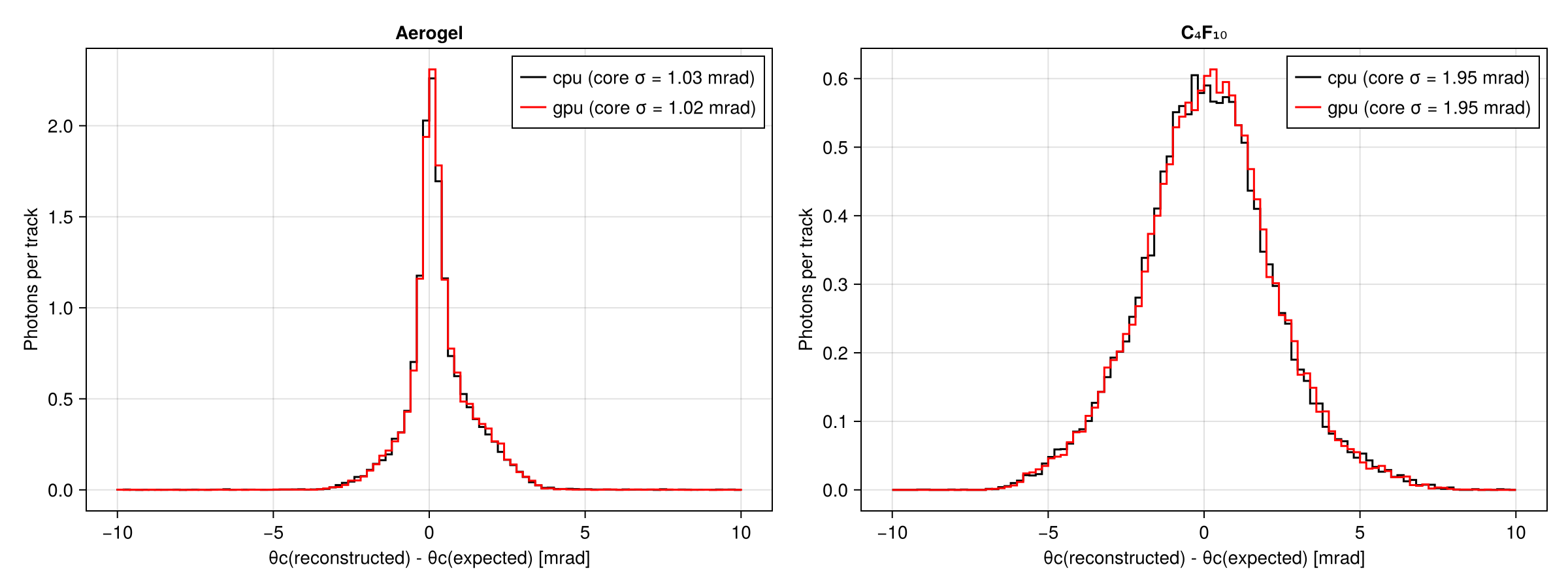
Throughput as a function of the batch size
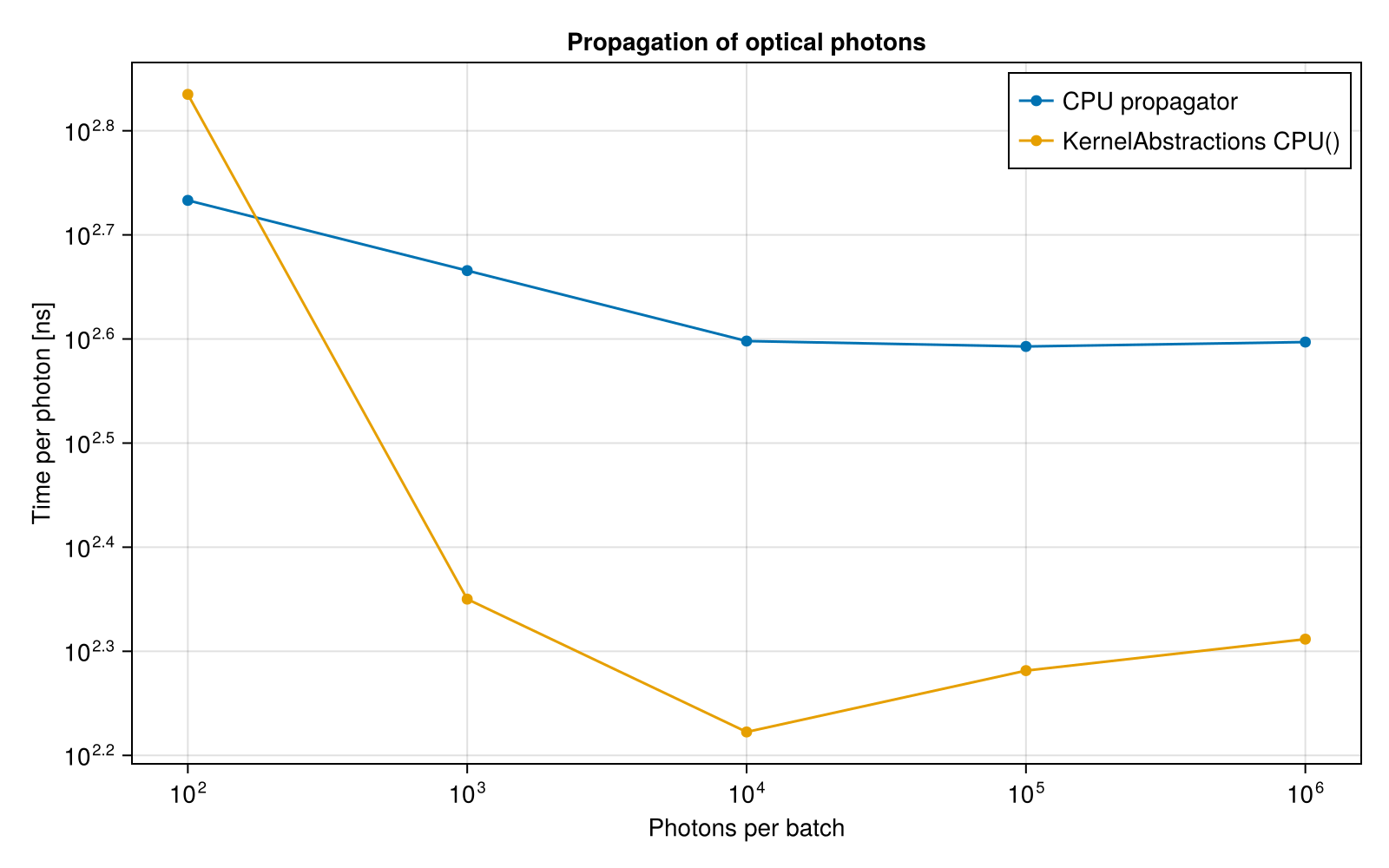
We collect the photons of 3000 events (more than a million photons) and propagate samples of increasing size with the CPU propagator (one thread), the kernel on the CPU backend (with all the Julia threads), and the kernel on the chosen backend. The time includes the copies to and from the device, but not the conversion to GPUPhoton.
data.mode = :collect
beamOn(app, 3000)
sample = copy(data.sample)
sizes = [10^k for k in 2:6 if 10^k <= length(sample)]
backends = [("CPU propagator", nothing, Float64), ("KernelAbstractions CPU()", CPU(), Float64)]
backend isa CPU || push!(backends, ("KernelAbstractions $backend", backend, T))

function timeit(f; repeat=3)
    f()                                            ## compilation and warm-up
    minimum(@elapsed(f()) for _ in 1:repeat)
end

fig = Figure(size=(800, 500))
ax = Axis(fig[1,1], xlabel="Photons per batch", ylabel="Time per photon [ns]", xscale=log10, yscale=log10,
          title="Propagation of optical photons")
for (label, bk, FT) in backends
    times = Float64[]
    for n in sizes
        photons = sample[1:n]
        if isnothing(bk)
            push!(times, timeit(() -> foreach(p -> propagate(tracer, p), photons)))
        else
            gp, gt = [toGPU(FT, p) for p in photons], GPUTracer{FT}(tracer)
            push!(times, timeit(() -> offload(bk, gt, gp)))
        end
    end
    scatterlines!(ax, sizes, times ./ sizes .* 1e9, label=label)
    @printf "%-30s: %s ns/photon\n" label join([@sprintf("%.0f", t/n*1e9) for (t, n) in zip(times, sizes)], " ")
end
axislegend(ax, position=:rt);
CPU propagator : 541 463 396 392 395 ns/photon
KernelAbstractions CPU() : 684 224 167 191 205 ns/photon
The figure shows the time per photon. The GPU needs large batches to beat the CPU.
This page was generated using Literate.jl.